

When Menopause Changes the Relationship You Have With Your Body
On Learning to Come Home to Yourself


Most of my writing on the menopausal transition has circled the relational and emotional terrain: the shifting dynamics in partnership, the renegotiation of roles, and the inner reorganization of a woman mid-metamorphosis. But there is another relationship here, one just as central and far less examined: the relationship a woman has with her own body.
Not simply how she feels about it, but how she has lived inside it. How she has used it. Managed it. Judged it. Ignored it. Pushed through it. Tried to perfect it. Tried to disappear within it. Tried, at times, to leave it altogether.
Because for many women, the body has rarely been experienced as a place to simply live. More often, it has been a place of responsibility. Accommodation. Survival. Caretaking. A thing expected to keep going no matter how exhausted, hormonally depleted, emotionally overwhelmed, or disconnected a woman may have become from herself.
Your body has carried you through decades of living. It has nurtured children, or the children of others, or the work that became your own kind of child. It has soothed fevers in the middle of the night, held friends while they wept, and stood at kitchen counters preparing raw ingredients into love. Somewhere along the way, it learned to adapt itself to the needs and expectations of others; to smile when exhausted, to look pleasing, to take up less space, to be agreeable, to be desirable, and to become whatever was needed. For decades, the body has been shaped around the care of everyone else.
And now, at this stage of life, it is asking something different.
The body and the soul meet each other differently at this threshold. The nurturing must now turn inward. You are being asked to be led by inner authority rather than external approval, by truth rather than expectation, by the deeper needs of the self rather than the endless demands placed upon it. Because the body houses the soul; it is the vessel, the anchor, the only home she has, and if you cannot learn to tend yourself, who will?
When the Body Stops Feeling Like Home
Society has never made this easy. The female body has never really belonged to the woman who inhabits it. It has been scrutinized, legislated, idealized, and commodified. We inherit a narrative written long before we arrived: that our bodies are projects, not companions. That they need fixing, shrinking, smoothing, and concealing. That our worth is tethered to how closely we approximate an image that was never designed to include us. And this starts early.
Before we understood what was happening, we understood that our bodies were being evaluated. A comment about chubby legs. A well-meaning relative who pinched a waist. A mother’s face in the mirror, the way she turned sideways and frowned. A magazine cover at the grocery checkout with a number on it: “Lose 10 Pounds by Summer,” and the unspoken promise underneath: your body, as it is, is wrong. We learned that the female body was not a home to inhabit but a surface to be judged.
And so we spend years, decades, warring with ourselves. We diet, we punish, we contort ourselves. We learn early that thinness buys you a kind of acceptance, that beauty opens doors, and that desirability can feel like safety. We hand our bodies over to the gaze of others and wait for the verdict. Belonging, we are taught, is something you earn by erasing enough of yourself.
And yet for some women, this description does not go far enough. For them, the body was never a project to be managed through willpower. It was a site of violation. A place where something happened that should never have happened. A body that was touched before she had any say in the matter, reduced before she understood what was being taken.
For these women, survival did not look like dieting or controlling the body, it looked like leaving. Dissociating. Rising up and out of the body because staying inside it was unbearable. It was the most intelligent thing a soul could do in an impossible situation. But it created a fracture, a distance between self and flesh that can last decades, and menopause, with its insistence that you return to the body, that you feel it, tend it, inhabit it, can feel less like an invitation and more like an ambush.
The stripping away of power happens so subtly that most of us do not notice it happening. We are reduced to parts: breast, waist, hip, butt, and the parts become the whole. Our hunger becomes a thing to override. Our fullness becomes something to fear. Our size becomes a moral category: small is good, smaller is better, and the smallest version of yourself is the one most worthy of love.
This is not an abstraction. It lives in the woman who has been counting calories since she was fourteen. In the one who cannot eat without calculating the cost, and In the woman who learned that food could be a substitute for love, for comfort, for the mothering she never received. Food becomes the quiet companion, the thing that soothes, that fills, that numbs. Not fuel. Not nourishment. A transaction with the ache.
And for some, that relationship tightens into something more dangerous.
This is the soil in which eating disorders grow. It doesn’t come from a desire to be thin for thinness’s own sake. But from the desperate, human need to feel safe inside a body that the culture has told you, from the very beginning, is not safe to simply inhabit. Restriction becomes a strategy. Control becomes a lifeline. The body becomes the one thing in a chaotic life that can be mastered, or so the mind believes, until the body, eventually, breaks the bargain. And then perimenopause arrives.
When the Old Strategies Stop Working
Perimenopause can begin as early as our late thirties, though most women feel its first tremors in their mid-to-late forties. Estrogen begins its gradual withdrawal, and with it, the body shifts. Weight redistributes. The strategies that used to work: the restriction, the careful accounting, and the exercise calibrated to burn exactly what was consumed, stop working. Or they work so poorly that the cost of maintaining them becomes impossible to ignore. The one thing that felt governable becomes ungovernable.
I think of Lauren, a composite of women I have known, standing in her bathroom at 5 a.m. after waking up drenched again. She had been meticulously logging every almond, every minute on the elliptical, and the scale had not moved in three weeks. Her hands were shaking as she zipped the scale into a suitcase and shoved it into the closet because something inside her finally realized: I cannot math my way out of this.
Because what begins to unravel during this stage of life is not simply a strategy. It is an identity. A way of relating to the body that may have been in place for decades. The belief that if you are disciplined enough, careful enough, small enough, you will finally arrive at peace. And when the body no longer responds in the ways it once did, many women are left standing in unfamiliar territory, grieving not only the changing body itself, but the loss of the illusion that control could protect them.
This is the moment the relationship cracks open. The old terms no longer hold. And the question that has been waiting underneath decades of management and control finally rises to the surface: now what?
For the woman who has spent decades in a strained relationship with her body, policing its size, managing its hunger, measuring her worth in inches and pounds, this convergence of physical change and emotional vulnerability is not simply difficult. It is destabilizing. And when the body changes in ways we cannot control, many of us reach for control wherever we can find it. Sometimes we find it again in food.
Our forties and fifties are frequently the years of maximum pressure: aging parents who need us, children who are leaving or struggling, or for those who had children later in life, the continued intensity of the caretaking role. Careers at their most demanding. Partnerships that have evolved into something requiring renegotiation. We are often exhausted before the hot flashes even begin.
And underneath all of this, there is the corrosive grief of what our culture tells us is happening: that we are becoming less. Less visible. Less desirable. Less relevant. These are lies. But they are lies with enormous cultural currency, and they do not land gently on a body that is already navigating so much.
It is worth naming the range of experience here, because this is not one story. It is many.
For some women, the distress of midlife weight gain is new. They have spent their adult lives in relative peace with food and body, and the changes of perimenopause: the thickening waist, the softening shape, arrive as a genuine shock. They look in the mirror and do not recognize the woman looking back. The distress is real, and it deserves to be named without minimizing it.
For other women, the weight gain of menopause lands on top of decades of struggle: chronic dieting, food anxiety, the endless undercurrent of body dissatisfaction lingering just beneath the surface of an otherwise full life. These women may never have had a clinical diagnosis, but their relationship with food has never been free. Menopause escalates the tension. The body that was manageable becomes unmanageable. The old tools no longer work. The resulting distress can feel, for the first time, like something that is spinning out of control.
And then there are the women for whom the culture’s reduction of the female body to parts hardened into something clinical. A diagnosable eating disorder. Restriction, bingeing, purging, and compulsive exercise: these are not separate from the culture that taught women their bodies exist to be looked at. They are the extreme end of a spectrum that runs through nearly every woman’s life.
Research suggests that approximately thirteen percent of women over fifty exhibit eating disorder symptoms, and when broader disordered behaviors: restriction, calorie counting, and compensatory exercise, are included, the number may be closer to twenty-nine percent. And yet these women remain profoundly underdiagnosed, because the story we tell ourselves, that eating disorders belong to the young, to the thin, and to the visibly fragile, is both wrong and dangerous.
This is the harvest. Decades of being told that our bodies are not ours. That they exist to be looked at. That their value is measured in inches and pounds, and the space they take up. The eating disorder, for the woman who develops one, is not an aberration. It is the culture’s logic, followed to its terrible conclusion. And perimenopause, with its hormonal upheaval, its loss of control, and its sudden unfamiliarity in the mirror, is the moment that logic can tighten its grip.
If the distress is no longer a passing wave but a weight that pins you down for weeks, if the only sense of control you can find is in eating less and less, this is a signal. When the brain cannot right itself despite every mindset shift and every compassionate reach, therapy and medication are not departures from the path: they are part of how some bodies find their way back to steady ground.
Menopause brings all of this to the surface. The body changes whether you consent or not. Softness arrives unbidden. Muscle mass begins its slow retreat. The old strategies stop working. The diets that once delivered a fleeting sense of mastery now deliver nothing but exhaustion. The mirror becomes unfamiliar. And something in you panics.
What If the Body Was Never the Problem?
But here is something that deserves to be said plainly: menopause, for all its difficulty, can also be a doorway, because it makes the old strategies impossible. It breaks the bargain. It removes the illusion that the body can be managed into submission, and in doing so, it opens a question that many women have never been given permission to ask: What if my body was never the problem? What if the problem was the relationship I was taught to have with it?
The word recovery is interesting. Re-cover. To cover again. But what if the work of this time is not to recover, not to return to something that was, but to discover, perhaps for the first time, a relationship with the body that does not require war?
This is not simple work. It asks a woman to unlearn the belief that her body is supposed to be small. To unlearn the belief that weight gain is failure. To unlearn the belief that her worth is contingent on her shape. To unlearn, in fact, the entire framework that reduced her to breast size and waist size and hip size in the first place. This is not work you do once. It is work you do again and again; each time the old voice returns, and the voice does return, especially when the body is changing in ways that feel unfamiliar.
To nurture yourself now means something different than it did before. It means feeding yourself not to shrink but to sustain. That is the first turn. The menopausal body needs protein, needs enough food, genuinely enough, because restriction worsens everything the body is already navigating. This is not about abandon. It is about asking your body what it needs rather than telling it what it cannot have.
And then there is movement. Not the movement we were raised on: the punishment cardio, the calories burned on a screen, the exercise undertaken as penance for the meal before or the meal to come. That was never relationship. That was transaction.
What I mean is the kind of movement that brings you back into your body rather than driving you out of it. The kind that says, “I am here. I am inhabiting this. I am building something.”
Lifting weights, at this stage of life, is not about aesthetics. It is about survival. You are losing muscle mass; that is the truth of this transition, and what you do not use, you will lose faster. But more than that, lifting is about something deeper. It is about feeling your own capacity answer you. It is about loading a bar and discovering that you are still someone who can bear weight. That your body is not fragile, and that strength is still available to you, waiting to be called back.
Strength Instead of Smallness
There is something defiant about a woman in midlife putting her hands on something heavy and lifting it. The culture expects her to shrink, to soften, to disappear. And she is in the gym, or her garage, or her living room, getting stronger. Not smaller. Stronger. The distinction matters. A smaller body is what the gaze demands. A stronger body is what the soul demands.
This has nothing to do with a scale. It has everything to do with fortifying the vessel that holds you. Because the years ahead will ask things of you physically, emotionally, and spiritually, and you want to meet them with a body that can carry what is asked. You want bones that resist fracture, a spine that holds you upright, and you want the resilience that comes not from controlling your shape but from building your capacity.
And here is what I have learned: the mind follows the body. When you strengthen yourself physically, something shifts in your interior. You begin to believe, at a cellular level, that you are not fragile. That you can endure. That you are still capable of power. This is not a metaphor. It is the alchemy of moving your own weight through space and feeling it answer. The soul listens when the body speaks.
The Long Way Home
But for some women, this invitation to inhabit the body is not a return to something familiar. It is a crossing into territory that has never felt safe.
If you are a woman who survived by leaving, who learned, early and well, that the body was a place where pain lived, where your agency was taken, where the only way through was to rise above it and watch from a distance, then the call to come back, to feel, to be in your body again, is not a gentle one. It can feel like being asked to move back into a house where someone hurt you. The walls are still standing. The memories are still in the floorboards.
This matters because menopause does not care about your history. It will summon you back to the body regardless. The hot flash, the night sweat, the ache in the joints, and the softening belly, these are bodily events, and they demand to be felt. You cannot dissociate your way through a body that is calling this loudly.
So how do we practice a return that does not retraumatize?
Gently. With infinite patience. With the understanding that the goal is not to rush into full inhabitation but to build a bridge, one plank at a time, between the self that learned to leave and the body that has been waiting.
It might begin with something as small as placing your hand on your own chest and feeling the warmth there for three breaths. Not forcing anything. Not demanding love or gratitude or any of the things the wellness world insists you ought to feel. Just noticing: I am here. This is my hand. This is my chest. The skin is warm. That is enough. That is the beginning of return.
It might grow into practices that anchor you in sensation without overwhelming you: walking barefoot on grass and noticing the texture, not the calories. Stretching slowly and following the edge of a tight muscle with curiosity rather than judgment. Lying on the floor with your legs up the wall and simply breathing, letting the ground hold you because that is what the ground does. These are not trivial acts. For a woman who has spent years outside her own skin, they are acts of reclamation.
It might mean choosing forms of movement that feel like safety rather than assault. Swimming, where the water holds you before you have to hold yourself. Yoga taught by someone who understands trauma, who does not adjust without asking, who lets you stay in the back of the room and move at your own pace. Walking in the woods, where no one is looking, and the only metric is whether you notice the light through the leaves.
And it almost certainly means support. A trauma-informed therapist who can sit with you as you name what happened and what it cost you. A bodyworker or somatic practitioner who understands that touch must be invited, never imposed. A circle of women, even one or two, who can hear your story and be a witness to your experience.
Menopause, in its strange and insistent way, asks us to pay attention to the body again. To listen differently. To begin turning toward ourselves with more care than criticism. And for the woman who has spent years living at a distance from herself, this stage of life: difficult, disorienting, and deeply real, can also become an opening. A chance to slowly begin feeling at home inside herself again.
You do not have to love your body to begin this. You do not have to feel grateful for it, or proud of it, or any of the things we are told we must feel. You only have to be willing to turn toward it. To not look away. To stay, for one moment longer than you think you can, and then another.
The soul is patient. It has been waiting a long time. And the body, even the body that has been through what yours has been through, knows how to heal when it is finally, safely, inhabited again.
And from that place, something begins to shift. Gradually, the relationship to your body starts to change. The body is no longer approached as an enemy to battle, discipline, or shrink into submission. It becomes something to listen to. Something to care for. Something worthy of nourishment, strength, rest, and attention.
You can choose food that fuels the life you actually want, not the shape you were told to want. You can begin to inhabit your body as home rather than as a renovation project that never ends. You can walk, stretch, rest, lift, and in all of it, you can stay in conversation with yourself, asking not “What will make me smaller?“ but “What will make me whole?”
Because asking a woman in her late forties, fifties, or sixties to maintain the body she had at twenty is not a health goal. It is an act of violence dressed up as wellness advice. The body has different needs now. It is built for different purposes. It has carried us through an enormous amount of life; through pregnancy perhaps, through grief certainly, through stress and love, and through every meal we ever ate and every step we ever took. It deserves something other than the ongoing punishment of our dissatisfaction.
For women whose relationship with food has hardened into something clinical, there is also the need for skilled support: therapists, dietitians, and physicians who understand the particular landscape of midlife. This work is too important and too nuanced to navigate entirely alone. Reaching out for help is part of learning to treat the body with the care and seriousness it has always deserved.
Menopause changes the conversation between a woman and her body. The old strategies stop working. The old bargains begin to break apart. And beneath all of that disruption, another possibility waits: that the body was never meant to be a project to perfect, punish, shrink, or abandon. That it was always meant to be a home. A place to inhabit. A place to listen from.
And perhaps that is part of what this stage of life is asking of us now, a different relationship with ourselves entirely. One built not on criticism or control, but on attention. Nourishment. Strength. Compassion. Presence.
The body has carried us through an enormous amount of life. It has endured far more than we acknowledge. Perhaps this stage of life is not asking us to perfect the body, but to honor it, strengthen it, reclaim our relationship with it, and finally fully inhabit it.
With love,
—Linda
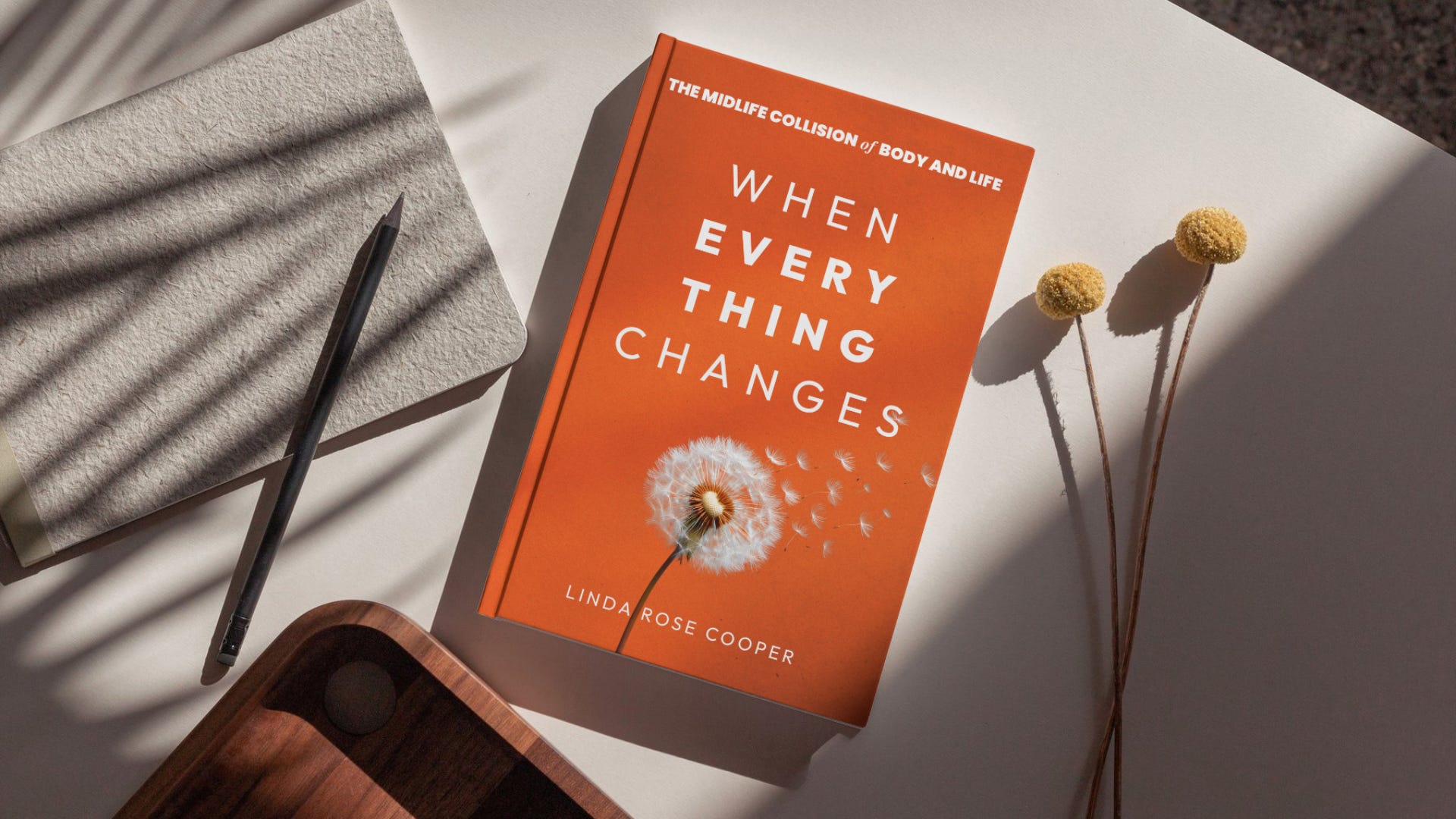
My book When Everything Changes offers a fuller exploration of the collision of body, life, and identity that so often defines midlife.
The nurturing must now turn inward — I've been sitting with that line since I read it.
For me the reckoning arrived on a couch, doom scrolling for inspiration on what to do next. Not a dramatic moment. Just the quiet horror of realizing I had no idea what I actually wanted — only what I was supposed to want next. I'm still working out the difference.
Linda, your description of "the bargain" breaking resonated deeply with me. After decades of disordered eating, menopause was the stage of life where I could no longer rely on the strategies that had helped me feel safe and in control. What initially felt like a crisis eventually became an opportunity to build a different relationship with my body.
I found myself returning to your insight between recovery and discovery. For many of us whose struggles with food and body image began so young, there is no earlier, peaceful relationship with our bodies to return to. The work becomes one of discovering, perhaps for the first time, what it means to live in our bodies with trust and compassion.
Thank you for giving voice to an experience that so many women are living but rarely speaking about.